India's mobile gaming market in 2026: what the numbers mean for game developers
Half a billion players, a ban on real-money games and a growing free-to-play market: what the latest 2025–2026 data says about gaming in India, and what it means for developers.
By Elvento Labs9 min read
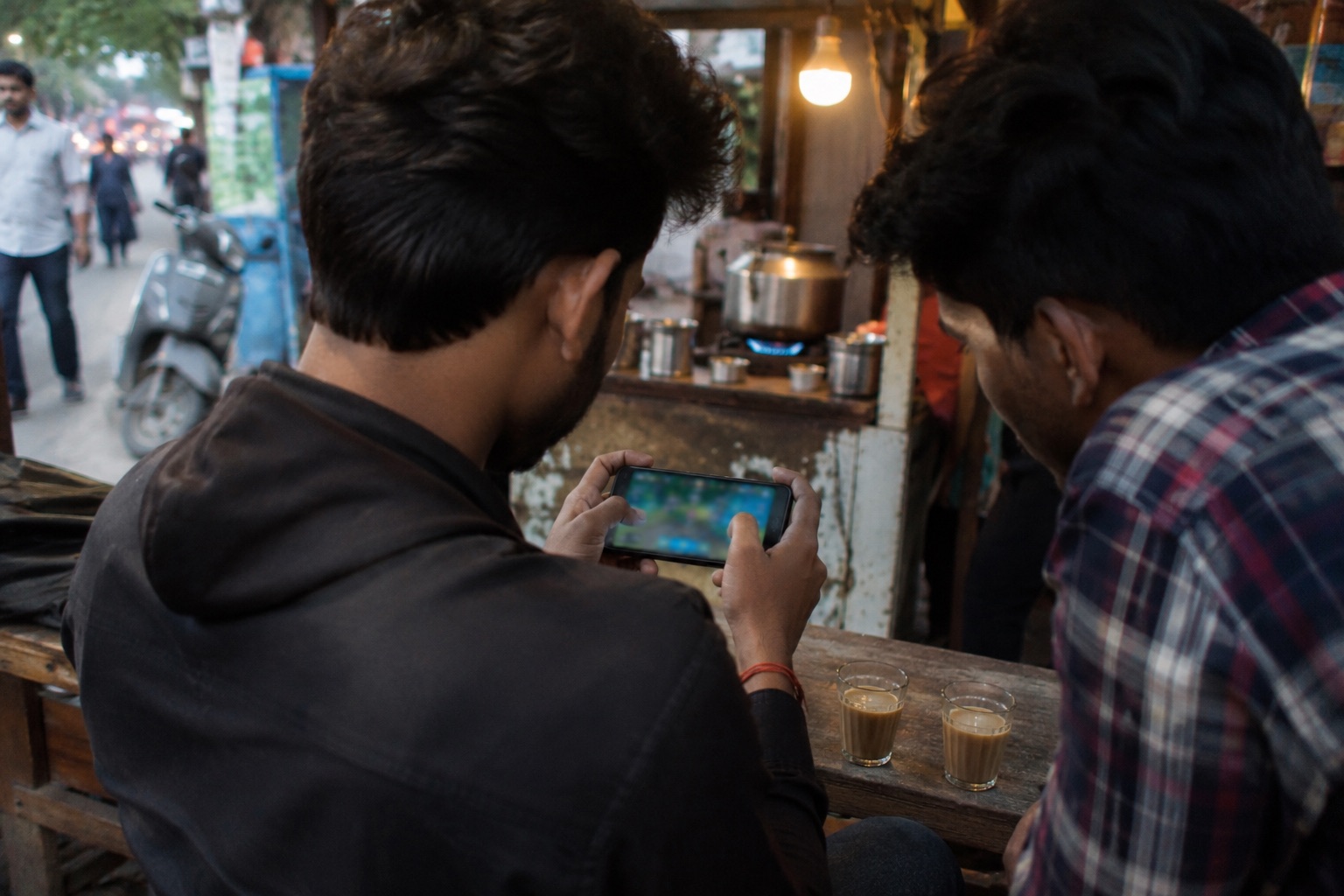
Ask three research firms how big India's games market is and you will get three different answers. That is not a reason to ignore the numbers. Read together, the 2025–2026 reports tell a clear story: hundreds of millions of players, a market that lost its biggest money-maker to a new law, and a free-to-play segment that keeps growing. Here is what the latest data says, where the sources disagree, and what we think it means if you are building a mobile game for Indian players.
The short version
- Around half a billion people play games in India, almost all of them on phones. Estimates for 2025 range from 511 million to 555 million.
- Free-to-play games are growing. Lumikai puts free-to-play revenue at US$1.5 billion in 2025, up 17%.
- Real-money gaming is banned. The Promotion and Regulation of Online Gaming Act, 2025 outlawed online money games, the segment that used to earn most of the market's revenue.
- India downloads far more than it spends. In August 2026 it accounted for about one in six of the world's mobile game downloads, but it is nowhere near the top of the revenue rankings.
- Players pay with UPI, on Android, on mid-range phones.
How many people play games in India?
| Source | Players | Period |
|---|---|---|
| Lumikai | 555 million (down 9% from 609 million) | CY2025 |
| FICCI–EY | 515–525 million; about 548 million expected in 2026 | 2025 |
| Niko Partners | 511 million | 2025 |
Sources: Lumikai's 2025 report as reported by Outlook Respawn (March 2026), the FICCI–EY media and entertainment report 2026 (March 2026), and Niko Partners (August 2026).
The counts differ because the definitions do, and because 2025 was the year real-money gaming was banned: players who only played fantasy sports or rummy for money dropped out of some counts. What the sources agree on is the shape. FICCI–EY estimates that about 95% of Indian gamers play on mobile, that more than 100 million play every day, and that more than 100 million pay for games. Lumikai puts the share of players who pay at 25%.
How much do Indian players spend?
Here the estimates differ even more, so it is worth seeing them side by side:
| Source | What it measures | Figure |
|---|---|---|
| Lumikai | Free-to-play revenue (excludes money games), CY2025 | US$1.5 billion, up 17%; forecast US$3.2 billion by 2030 |
| Niko Partners | Player spending, 2025 | US$1.04 billion, up 14.8% |
| FICCI–EY | Video games and esports, 2025 | ₹63 billion (₹57 billion in 2024); forecast ₹74 billion in 2026 and ₹92 billion in 2028 |
Within FICCI–EY's figure, in-app purchases grew from ₹31 billion to ₹36 billion in 2025 and advertising from ₹14 billion to ₹15 billion, while esports slipped from ₹13 billion to ₹12 billion. (FICCI–EY report, March 2026)
Spend per player is low by global standards. Niko Partners puts average revenue per player at US$2.04 a year. Lumikai estimates that paying players spend about US$15 a year on mid-core games and about US$3 on casual games, and that rewarded video ads earn an eCPM of about US$2.43, against US$1.1 for ads overall.
Downloads are high, revenue is not
India is one of the two largest markets in the world for mobile game downloads. In August 2026 alone, players in India downloaded 614 million games, 16.4% of the 3.76 billion downloaded worldwide, while the top revenue markets that month were the United States, China (iOS) and Japan. (Sensor Tower, September 2026)
The gap is narrowing. In the first quarter of 2026, mobile game revenue in India grew 15% year on year, against 0.4% worldwide. (Sensor Tower, April 2026) Lumikai also notes that games make up 36% of the revenue of India's top 25 apps but only 8% of their downloads: players who do pay, pay for games.
The Online Gaming Act, 2025 changed the market
Until 2025, real-money games such as fantasy sports, rummy and poker were the largest part of India's online gaming revenue. That changed with the Promotion and Regulation of Online Gaming Act, 2025.
- What it does. The Act bans offering, advertising and processing payments for "online money games", whether they are games of skill or of chance. Offering such games or processing payments for them can bring up to three years in prison and a fine of up to ₹1 crore. At the same time, the Act sets out to promote esports and social games. (PRS Legislative Research)
- When. Parliament passed it on 20–21 August 2025 and it received presidential assent on 22 August 2025. It came fully into force on 1 May 2026, when the Online Gaming Authority of India was set up. (SCC Online) The rules require esports games to register; social games only need to register if the government notifies them. (MediaNama)
- The impact. Companies including MPL, Zupee and Gameskraft stopped their paid games within days of the bill passing. (TechCrunch) FICCI–EY's figures show India's online and video games revenue falling from ₹236 billion in 2024 to ₹195 billion in 2025, and EY expects the growth of other games may not make good the gap the ban left.
The Act has been challenged in the Supreme Court, so check where that stands before relying on it. For developers of ordinary games, the practical result is simple: the money that used to flow to real-money platforms is looking for a new home, and free-to-play, casual and mid-core games are where the growth is.
What Indian players play
Revenue in India is concentrated in a few genres. Sensor Tower's data, published in the FICCI–EY report, shows how different the download and revenue charts look:
| Genre | Share of downloads | Share of in-app revenue |
|---|---|---|
| Shooter | 6% | 43% |
| Strategy | 2% | 12% |
| Puzzle | 16% | 12% |
| Casino | 3% | 11% |
Free Fire and Battlegrounds Mobile India (BGMI) account for about 90% of shooter revenue. The top-grossing mobile games in India in 2025 were Free Fire, BGMI, Coin Master, Candy Crush Saga, eFootball, Roblox and Pokémon GO, according to AppMagic data (Outlook Respawn). Garena launched a localised Free Fire India on 28 October 2026, four years after the original was banned. (TechCrunch)
Battle royale is not the whole story, though. Niko Partners found that games outside battle royale grew from 53.2% of India's mobile game revenue in June 2023 to 62.8% in June 2026.
Devices, data and payments
- Android is almost everything. In October 2026, Android ran on 94.84% of mobile devices in India, iOS on 5.1%. (StatCounter)
- Phones are mid-range and getting pricier. India's smartphone shipments in 2025 were 152 million, at a record average price of US$282. Phones priced between US$100 and US$200 made up 41% of shipments. (IDC via EE Times India) With memory costs rising, the share of phones under US$100 fell from 18% to 8% in early 2026. (IDC via Business Today) Most players, though, are still on the phones they bought in earlier years.
- Data is cheap. Mobile data in India cost about US$0.16 per GB in Cable's last worldwide study (2023), the seventh cheapest of 237 countries. (Cable)
- Players pay with UPI. In a Lumikai survey of more than 3,000 smartphone users, 80% of people who pay for games use UPI, ahead of wallets (10%), debit cards (7%) and credit cards (3%). Google Play in India accepts UPI from all providers, including UPI AutoPay for subscriptions. (Google Play Help)
Made-in-India games
Indian studios do well on downloads: casual games like Ludo King and Indian Bikes Driving 3D sit near the top of the download charts. Revenue is harder. FICCI–EY reports that Indian publishers had 37% of app downloads in India in 2025 but only 9% of app revenue, and several of India's most successful studios, such as Gameberry Labs (the makers of Ludo STAR) and PlaySimple, earn most of their money abroad.
There is a clear appetite for games that feel Indian. SuperGaming's Indus Battle Royale, built in Pune, passed five million Google Play downloads by November 2024, and FICCI–EY expects Indic themes, regional-language interfaces and cricket tie-ups to be among the trends that shape the next few years.
What this means if you are building a game for India
This is our reading of the numbers, as a studio that ships games for Indian players.
- Build for the phone people actually own. That means a mid-range Android phone, often a few years old. Treat download size, memory and battery as features. We cover this in our guide to the mobile game development process.
- Monetise with ads and small, fair purchases. Casual players spend little, so rewarded ads and low-priced unlocks matter. Set the rupee price yourself rather than accepting a converted one: our horror game Last Attendance unlocks its second chapter for a single ₹49.
- Make it feel Indian, not translated. A street-cricket game where the neighbour's window gets you out, a Holi colour war, a hostel roll call: specific places and habits travel further than generic ones. Then localise it properly.
- Plan for the world as well. India gives you reach; revenue often comes from abroad. Design so the game works for players in other markets too.
- Stay well clear of money mechanics. Anything that lets players stake money for a chance to win money now falls under the Online Gaming Act. Take legal advice on any mechanic near that line.
Frequently asked questions
How big is India's mobile gaming market in 2026?
Excluding real-money games, estimates for 2025 range from about US$1 billion in player spending (Niko Partners) to US$1.5 billion in free-to-play revenue (Lumikai). FICCI–EY values video games and esports at ₹63 billion in 2025 and expects ₹74 billion in 2026.
How many mobile gamers are there in India?
Between about 511 million and 555 million people played games in India in 2025, depending on the source. FICCI–EY estimates that about 95% of them play on mobile.
What does the Online Gaming Act, 2025 ban? Are in-app purchases still legal?
The Act bans offering, advertising and processing payments for online money games: games where players pay or stake money expecting to win money or other stakes. It does not ban games that are not money games, and it sets out to promote esports and social games. Ordinary in-app purchases and ads in such games are not what the Act targets, but if your game has any mechanic close to staking money, get legal advice.
How do Indian gamers pay for games?
Mostly with UPI. In Lumikai's survey, 80% of players who pay for games use UPI, and Google Play in India accepts UPI, including AutoPay for subscriptions.
Which game genres earn the most in India?
Shooters, led by Free Fire and BGMI, earn about 43% of India's mobile game in-app revenue from just 6% of downloads. Strategy and puzzle games earn about 12% each, and casino games about 11%.
Build for Indian players with us
Elvento Labs is a game development studio in Noida. We have shipped six original games on Google Play, and we build games for publishers and brands, from the first prototype to launch and live operations. If you are planning a game for India, tell us about it.