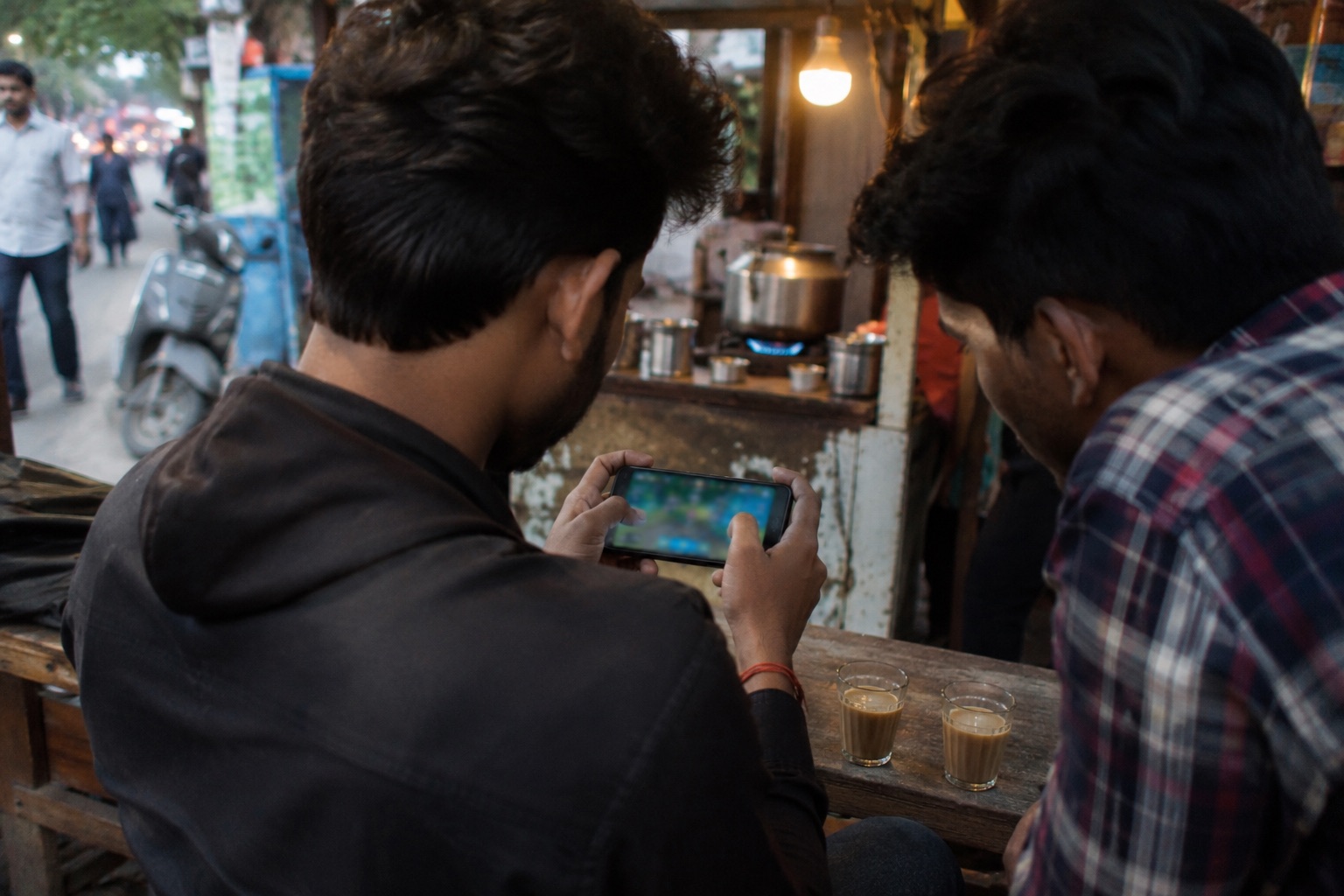
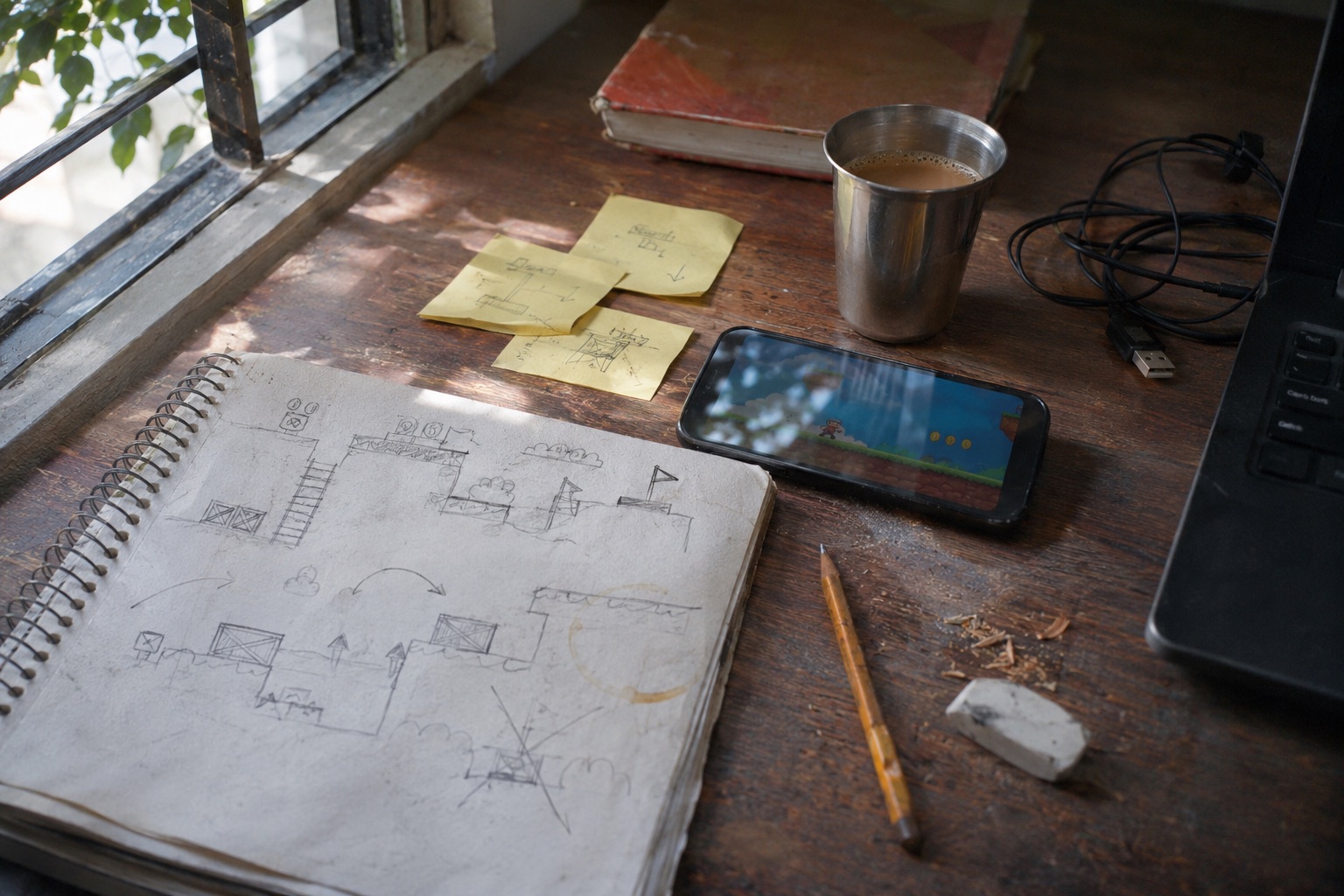
How to localise a mobile game for India: Hindi, Hinglish and voice
What we have learned shipping a game in Hindi and English: who you are localising for, Hindi versus Hinglish, rendering Devanagari in Unity and Unreal, voice, subtitles and the store listing.
By Elvento Labs9 min read
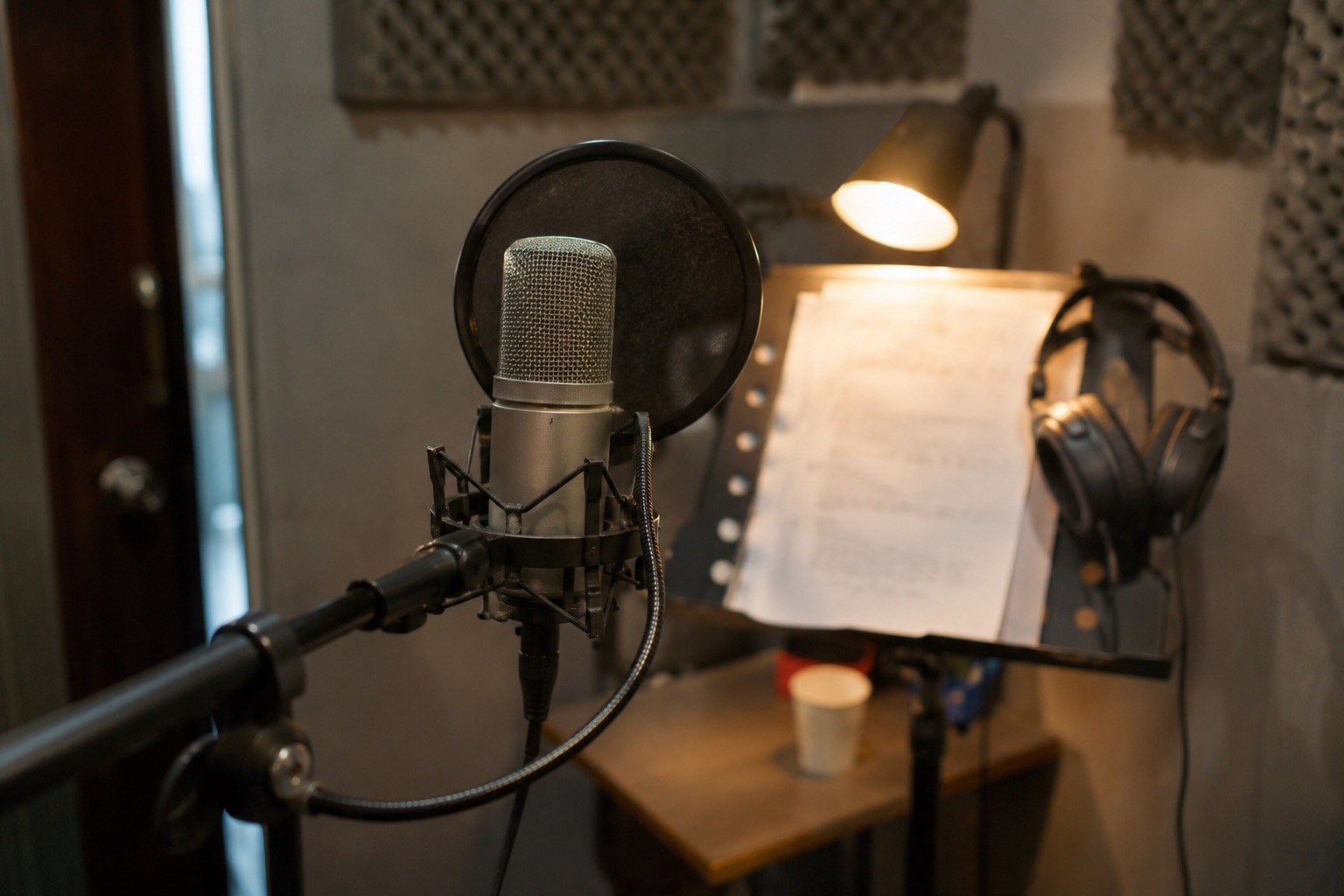
India is one market with a great many languages, and most of its players do not live in the big metros. If your game only speaks English, a large share of them will meet it as a foreign product. Our horror game Last Attendance ships with Hindi and English voices and subtitles, because the story is set in an Indian boys' hostel and the lines only work the way people there actually say them. This guide covers what we have learned about game localisation for India: who you are localising for, Hindi versus Hinglish, making Devanagari render properly in Unity and Unreal, voice and subtitles, and the Google Play store listing.
Why localise for India at all
Start with who your players are.
- Hindi is the largest language, but not a majority. In the 2011 Census, the latest with language data, 43.63% of Indians gave Hindi as their mother tongue. That census figure groups several related languages under "Hindi"; Hindi in the narrow sense is closer to 26.6%. The next largest are Bengali (8.03%), Marathi (6.86%), Telugu (6.70%) and Tamil (5.70%), and India has 22 scheduled languages in all. (Census of India 2011, Language, Table C-16) The next census, with a reference date of 1 March 2027, will update these numbers.
- Indians use the internet in their own languages. The IAMAI and Kantar Internet in India 2024 report found that 98% of internet users, about 870 million people, accessed content in Indic languages, and that 57% of urban users prefer Indic-language content. (IAMAI–Kantar, Jan 2025)
- Gamers are spread across the country. Lumikai's State of India Interactive Media & Gaming report for FY24 counted 591 million gamers and found that 66% of them live outside the metro cities. (Lumikai, FY24 executive summary)
An older study is still worth knowing: KPMG and Google's 2017 report found that 88% of Indian-language internet users were more likely to respond to an ad in their own language. (KPMG–Google, 2017) The internet has grown a lot since, but the direction has not changed.
Decide how far to localise
"Localised" covers a wide range. It helps to pick a level on purpose, because each one changes the work involved.
| Level | What it includes | What it takes |
|---|---|---|
| Store only | Translated store listing and screenshots | A translator and new screenshots |
| Text | UI, tutorials and menus translated | Font support for Devanagari, layout fixes, testing |
| Subtitles | All dialogue and story text translated | A script pass for tone, subtitle timing |
| Full voice | Spoken dialogue recorded in Hindi (and English) | Casting, directing, recording and mixing two languages |
| Cultural | Settings, names, humour and references that belong in India | Decided at the design stage, not added at the end |
The last level is the one that cannot be bought later. In Last Attendance, the hostel, the Warden's roll call and the almirah you hide in are part of the design. No amount of translation would have turned a generic haunted house into that.
Hindi, Hinglish or both?
Many players do not speak "pure" Hindi online. They mix Hindi and English, and they often write Hindi in the Roman alphabet. A Microsoft Research India study of about 859,000 tweets from around Delhi found that 26.46% mixed Hindi and English, and almost all of that mixed text was written in Roman script (24.2%, against 0.12% in Devanagari). Tweets in pure Hindi, on the other hand, were mostly in Devanagari. (Microsoft Research India, LREC 2020 workshop)
That suggests a split that matches what we hear from players:
- Dialogue should sound like people talk, which in much of North India means Hinglish. In Last Attendance the Warden says "Attendance toh deni padegi". Translate "attendance" into formal Hindi and the line stops sounding like a hostel and starts sounding like a government form.
- UI and menus read best in clear, simple Hindi in Devanagari when the player chooses Hindi, with English kept for widely used gaming words like "level" or "settings" where the Hindi equivalent would be unfamiliar.
- Marketing copy and social posts can use romanised Hinglish. Our cricket game's tagline is "Har gully ka apna king": that is how a fan would type it.
Whatever you choose, let players set the voice language and the text language separately. Plenty of players want Hindi voices with English subtitles, or the other way round.
Make Devanagari render properly in your engine
Hindi in Devanagari is not just a different set of letters. Consonants join into conjuncts (क + ष becomes क्ष), and vowel signs move: the short "i" sign ि is written before the consonant it follows in speech. A text system needs a shaping step to get this right. Without it you get broken conjuncts and floating vowel signs, and Hindi readers notice immediately.
Unity. Unity 6's UI Toolkit has an Advanced Text Generator that uses HarfBuzz, ICU and FreeType to shape complex scripts. It is off by default, works only with dynamic font assets, and adds about 4.8 MB of ICU data to the build. Unity's manual highlights Arabic and Hebrew rather than Hindi, so test your Hindi strings rather than assume. (Unity 6 Manual) TextMeshPro, the text system many Unity games use, is a different story: as of January 2026 developers were still reporting broken conjuncts such as क्ष and ज्ञ and misplaced vowel signs in Unity 6, with no official fix. (Unity Discussions) If your UI is built on TextMeshPro, decide early whether to move Hindi text to UI Toolkit or add a HarfBuzz-based shaping step.
Unreal. Unreal uses HarfBuzz for shaping, and it has a text shaping setting with three values: Auto, KerningOnly and FullShaping. Unreal's documentation describes Auto as using kerning only for left-to-right text, and Hindi is left-to-right, so check that Hindi text is getting full shaping and confirm it on a device.
Wherever you build, a few habits save time:
- Choose fonts that cover both scripts. Fonts such as Noto Sans Devanagari pair Devanagari with a matching Latin design, so mixed Hinglish UI does not look stitched together.
- Give lines more height. Devanagari has a headline (the shirorekha) and vowel signs above and below it. Line heights tuned for English clip them.
- Test with hard strings. Add a debug screen with words like क्षत्रिय, ज्ञान, श्री and द्वार, and check it on a low-end Android phone, not only in the editor.
Voice and subtitles
Voice. Cast actors who speak the register your characters speak, not just the language. A Delhi hostel warden, a Mumbai cricket commentator and a radio host at 2 a.m. sound different, even in the same language. Record both languages with the same direction so the scenes play the same way, and plan for pickups: lines change late.
Subtitles. Microsoft's Xbox Accessibility Guidelines are a good, current baseline for any platform (XAG 104, updated Nov 2026):
- Show the speaker's name whenever the speaker changes.
- Turn subtitles on by default, or let players choose before any dialogue plays.
- Keep to at most 40 characters per line and two lines on screen.
- Offer a background behind the text with adjustable opacity, and let players scale text up to 200%.
For mobile text size, the same guidelines set a minimum text height of 18 px at 100 DPI, scaling with screen density (XAG 101); the Game Accessibility Guidelines suggest at least 46 px at 1080p for subtitles (Game Accessibility Guidelines). Treat these as minimums for Devanagari, whose vowel signs are the first thing to disappear at small sizes.
Localise the store listing too
Players decide in the store, so the listing deserves the same care as the game. On Google Play (Play Console Help):
- Add translations yourself for Hindi (hi-IN) and English (India) (en-IN), and for Bangla, Gujarati, Kannada, Malayalam, Marathi, Punjabi, Tamil, Telugu and Urdu if you support them.
- Use a human translator for Hindi. Hindi is not on the support page's list of languages for Play's free machine translation, and Play Console offers paid human translation starting at around US$0.07 per word.
- Localise screenshots and graphics per language, so a Hindi listing shows the Hindi UI.
- Use custom store listings (up to 50, targeted by country) when you want India to see a different pitch. (Play Console Help)
Set the India price deliberately. Google Play converts your price into rupees using exchange rates and local pricing patterns, and you can override it per country. Pricing templates were retired on 27 October 2025, so set India's price directly. (Play Console Help) A converted price rarely lands on a number Indian players expect; Last Attendance's second chapter is a single ₹49 unlock.
A localisation checklist
- Chosen level of localisation, decided at the design stage
- Hindi, Hinglish or both, chosen line by line for tone
- Separate voice and text language settings
- Devanagari shaping working on a low-end Android phone
- Fonts that cover Devanagari and Latin, with taller line heights
- Subtitles with speaker names, a background and scalable text
- Store listing, screenshots and price set for India
Frequently asked questions
What is game localisation?
Game localisation is adapting a game for players in another language and culture: translating its text and dialogue, recording voices, adjusting fonts and layout, and changing anything that would not make sense or feel right to those players, from jokes and names to prices.
How much does it cost to localise a game into Hindi?
It depends on how far you go. The cost is driven by the word count of the UI and script, the number of voiced lines and characters, review and testing passes, and the engineering to render Devanagari properly. A translated store listing alone is a small job; full Hindi voice is a production in its own right. Scope it by word count and voiced lines before you ask for quotes.
Should I use Hindi or Hinglish for Indian players?
For dialogue, usually Hinglish, because that is how many players speak. For UI, clear Hindi in Devanagari, keeping English for familiar gaming terms. Let players choose voice and text languages separately.
Which Indian languages should I add after Hindi?
Let your player data decide. By population, the next largest mother tongues in the 2011 Census are Bengali, Marathi, Telugu and Tamil. South Indian languages in particular are a different market from Hindi, not a variant of it.
Why does Hindi text look broken in Unity?
Because Devanagari needs text shaping to join conjuncts and place vowel signs, and not every Unity text system does it. Unity 6's UI Toolkit can shape complex scripts with its Advanced Text Generator (off by default); TextMeshPro has had reported problems with Hindi conjuncts. Test with hard strings on a real device early.
Localise with us
Localisation for India is one of the services we offer: Hindi and English scripts, voice casting and direction, subtitles and UI text, built in from the start of a project. If you are planning a game for Indian players, read our guide to the mobile game development process, or send us a brief.